Tool 3 – Call & Funding Recommendations

How to develop funding calls for supporting sustainable food systems?

FOODPathS offers practical recommendations to guide you in developing funding opportunities that drive inclusive and sustainable food systems. These recommendations are based on an analysis of 21 funding calls, including those from ERA-NETs, Horizon Europe Partnerships, regional calls, and Foundations, with a focus on integrating a food systems approach into future funding mechanisms.

Who is this tool for?

The tool is for any stakeholder supporting sustainable food systems, aiming to foster sustainability for people and the planet such as,

  • Private and public funder organizations
  • EU Commission
  • FutureFoodS Partnership
  • Any other grant-making organizations.

What are the benefits?

✅Provides clear guidance for developing impactful funding opportunities.

✅Supports alignment with a food systems approach.

✅Promotes impact by focusing on funding calls that create long-term, positive change in food systems for both people and the environment.

Main recommendations for developing a call on SFS:

  1. Provide a definition of systems approach or a clear explanation of what is meant;
  2. Be mindful and consistent with terminology, e.g. when using typical elements of a systems approach such as multi-/inter-/transdisciplinarity;
  3. Cross-disciplinarity, stakeholder engagement, and multi-actor approach are highly demanded and also of great relevance for a systems approach call; think about where and how to ask for these aspects and consider the differences between the concepts;
  4. When applying a systems approach it is important to consider both synergies and trade-offs;
  5. Think about how impact shall be achieved by the projects, how the food systems approach contributes to impact and provides guidance and support towards applicants;
  6. What additions to the proposals are sensible and what shall they contain (e.g. impact plan, Dissemination Exploitation Communication plan, stakeholder engagement plan, implementation/valorisation plan, etc.); adapt to the systems approach and consider also follow-up and adjustments over time (revisiting the plan);
  7. Networking activities facilitated at programme level can be valuable to align and/or collaborate with other projects or programmes but they need to be backed up with dedicated resources (they might even be a necessity for co-design and co-creation);
  8. Be open to new funding instruments beyond classical projects (e.g. knowledge hubs) to create mechanisms for fostering connectivity, co-creation and inclusiveness.

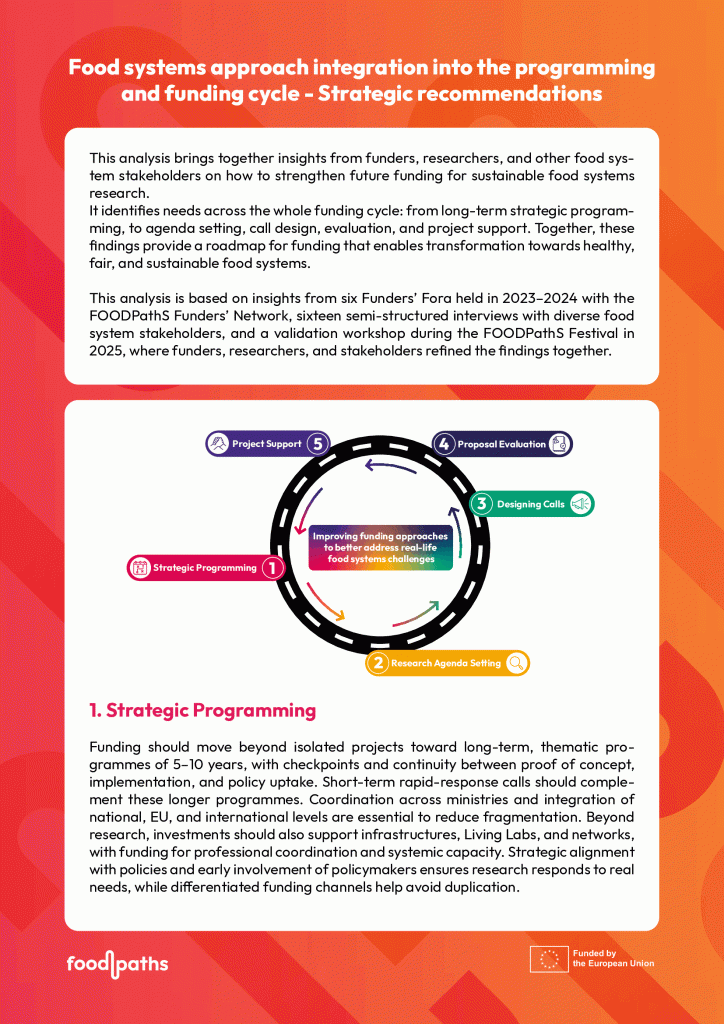
A road for funders

Strategic alignment with government policies(e.g., ministries, local needs). Include policy makers as advisors from the beginning. Support multi-actor, real-world research environments(e.g., DARPA-style models). Differentiate between different funding channels toavoid duplication. Invest in research infrastructure, Living Labs,and knowledge platforms. Fund professional coordination, not just research tasks. Build systemic capacity (e.g. knowledge brokers,institutional champions). Integrate national, regional, and EU-level funding instruments. Include international actors beyond the EU(e.g., Canada, Global South). Move from project-based to thematic or program-based funding. Allow 5–10 year funding to align with real innovation cycles(with regular checkpoints) Run short-term/rapid-response calls in parallel withlong-term programmes. Coordinate across ministries to reduce fragmentation. Ensure continuity between research phases: proof of concept →implementation → policy uptake/follow-up funding. Emphasize transparent, bottom-up agenda settingthrough public consultation. Conduct stakeholder mapping to prioritizeunderrepresented voices. Integrate national, regional, and EU-level funding prioritiesby building a joint narrative, while acknowledging nationaland regional differences Fund research that spans food, health, education,environment, culture. Break disciplinary silos by involving diverse ministries andsectors (e.g. agriculture, education, health). Embed sustainability and health in every research line asmandatory dimensions. Include indigenous, small, and remote communities insetting agendas. Use formats like vouchers or co-creation to give smalleractors a voice. Focus on vulnerable groups for highest social return. Offer small and large instruments: e.g. vouchers, seed grants,full grants. Use mixed models (e.g. 10% common pot, 90% national funding). Allow in-kind contributions for broader access. Offer two-step proposals (1st stage “project idea”,2nd stage full proposal) Offer staged funding or continuation calls Co-create call texts with experts from food systems, health,sustainability. Avoid overly broad themes—ensure thematic clarity and focus. Fund consortia across sectors and countries. Align research more closely with policymaking, education systems, and industry Promote joint approaches wherever possible (e.g. mixed cohorts) Allow more time for proposal preparation. Provide partnering tools to help applicants find new collaborators. Reduce bureaucracy and adapt application criteria for smallactors (who don’t have dedicated project coordinators on theirstaff for applying to funds). Stagger calls to reduce overlap and increase preparation time. Allow flexibility within budget lines Re-evaluate standard costs to enable participation in consortia. Allocate budgets specifically for high-risk, high-reward research. Support "proof of concept" and top-up funding at the end ofprojects to ensure uptake. Require researchers to define expected impact from the start Encourage thinking beyond projects—towardsustained transformation. Integrate dissemination into project design (up to 30% ofbudget suggested). Encourage stakeholder inclusion (e.g. vulnerable populations,youth) in the research design (especially of vulnerable populations,youth, and patients) Define and use multidimensional impact indicators (social, cultural,health, economic, environmental). Reduce overemphasis on researcher CVs andscientific "excellence". Integrate impact, relevance, andtransdisciplinarity into scoring. Consider fit-for-purpose metrics rather thanstandard KPIs. Evaluate implementation potential separatelythrough reviewers with implementation expertise Include stakeholders, private sector,early-career researchers. Train evaluators in food systems andtransdisciplinary approaches. Use both academic and non-academic reviewers. Enable feedback cycles during proposal review. Use AI-assisted proposal screening withhuman oversight. Consider two-stage applications with light1. step concepts Fund follow-up activities and valorisation (e.g., separatefund for exploitation). Promote use of existing research (avoid duplication). Bundle results for reuse and scale-up. Provide implementation resources (e.g. Videos,implementation plan template) Continuous evaluation—not only at project end. Site visits, phone check-ins, and feedback loops. Connect projects (ex. Project leader meetings) forsynergy (e.g., thematic clusters). Use platforms or knowledge bases to documentimpact stories. Enable data-sharing Promote scale-up Fund facilitators, and communication brokers. Focus on and fund communication efforts. Encourage use of Living Labs, team-building events,exchange programs. Frequent monitoring of external reviewers. Buddy system pairing early-career researcherswith experienced ones. Exchange programs to promote crossover experiences Rotating research roles to foster knowledge growth(mobility of skills)

Download the factsheet about the FOODPathS Road for Funders and consult our strategic recommendations food systems approach integration into the programming
and funding cycle